No, You’re Not Weak

Have you ever noticed that in the very moments when you want to stand tall, your body sometimes makes you black out—and the next second, you’re already on the ground?
Last month I caught the EBV virus (honestly, I had no idea what the fxxk this virus even was), and luckily my immune system fought it off. I’ve recovered now, but the virus invaded my vestibular system and left me with lingering nerve damage. That part doesn’t really bother me. What bothers me is that I still feel dizzy when I’m walking in the dark, even after a month.
One day, I actually collapsed in the shower. All I did was close my eyes while rinsing shampoo out of my hair—and suddenly, blackout. Just seconds of nothingness before I hit the ground. It made me wonder: why does our body make us “black out” before falling?
Most people explain fainting biologically — blood pressure suddenly drops, the nervous system can’t keep enough blood flowing to the brain, so consciousness shuts off. But think of it like a car: when the engine overheats or oil runs too low, the system forces a shutdown to prevent real damage. In the same way, fainting isn’t just a failure — it’s the body’s wisdom, an emergency brake that sacrifices a moment of control so the whole system can recover and survive.
Think about it. Why does your body choose to “give up” standing rather than force itself to hold on?
And then, ask yourself: in life and work, do you sometimes do the opposite? Do you force yourself to keep going when every signal says “stop”?
Entrepreneurs, designers, consultants—we’re all guilty of this. Working nights for weeks, ignoring our biology, chugging energy drinks instead of listening to what our bodies are trying to tell us.
At first glance, giving up or slowing down seems like laziness. It feels shameful to quit at 30%. But what about when you’re already at 85%, 90%, even 95%? Is it still weakness—or is it smart?
This isn’t an article about “how to give up.” It’s a reminder: your energy and health are the foundation for everything.
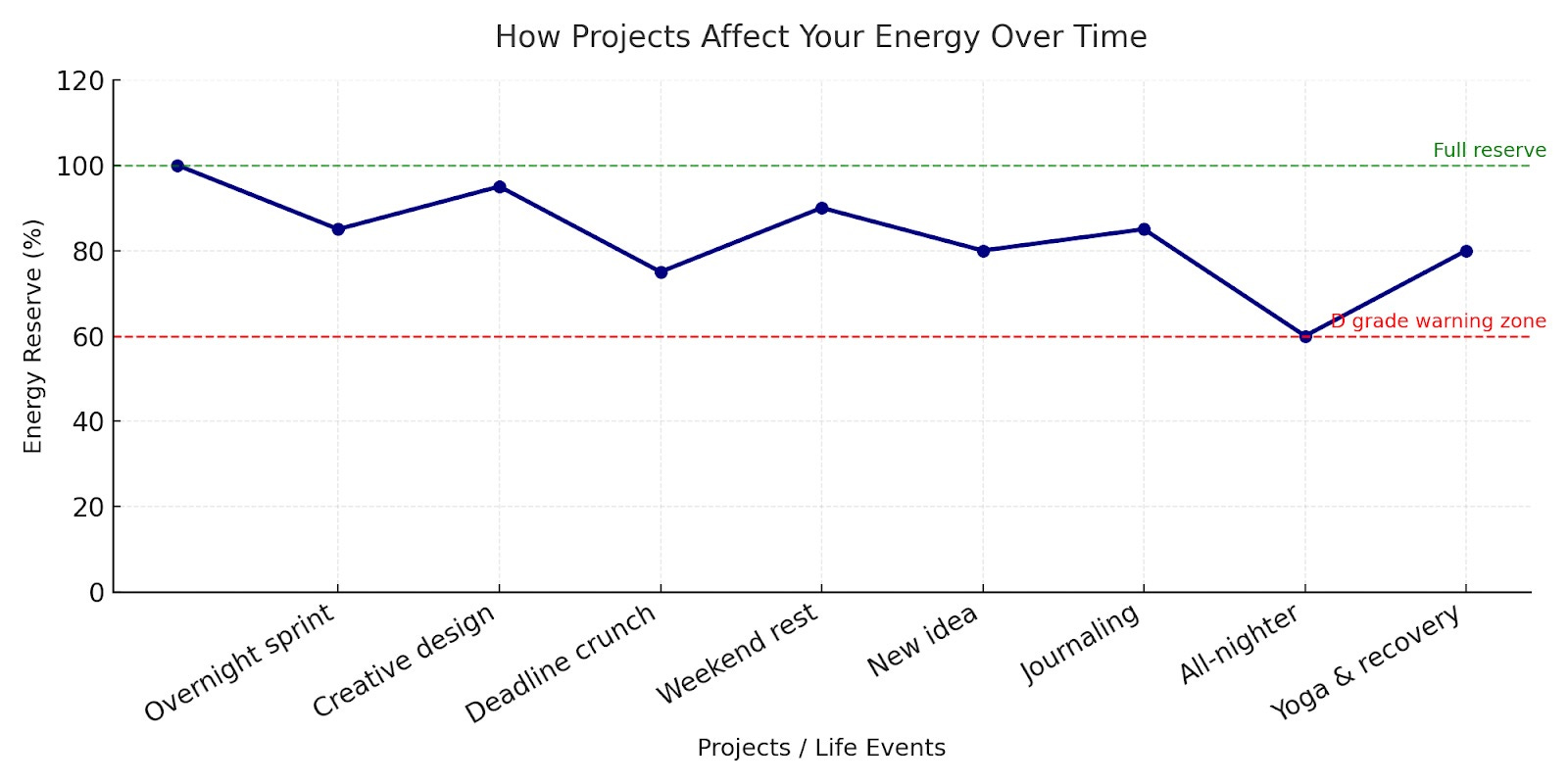
Here’s a simple way to picture it. Imagine you push yourself past your limits ten times in a row. If you lose just 5% of your capacity each time, what’s left? 95%^10 ≈ 60%. That’s basically a D grade. Even elementary school kids know a D is a warning sign. It means something’s broken, and you need to pause, diagnose, and fix it before moving forward.
So maybe next time you’re deciding whether to keep pushing or to rest, remember: your body’s “black out” might actually be a protective compromise—a built-in safeguard. Paying attention to that mechanism could be the difference between collapsing later… or walking further.
To better manage my health and energy, I’ve found it useful to take micro-pauses or short meditations—just five minutes away from the phone and work to feel what my body is telling me. Listening to signals like dizziness or headaches can be paired with these breaks, and if pausing feels distracting you from the working mode, drawing a simple diagram or tracking events can help reveal what drains or refills your energy. Even the things that harm your health don’t always need to be avoided, but keeping track, noticing patterns, and setting gentle alarms for yourself can make life easier and healthier.