
If You Can’t Focus, You’re Building Someone Else’s Dream
how to change your life in 3 months

“The only way to do great work is to love what you do. If you haven’t found it yet, keep looking. Don’t settle. As with all matters of the heart, you’ll know when you find it.” — Steve Jobs
Most people waste their life building someone else’s dream. They follow rules created by societies. Graduate. Get a job. Get married. Buy a house. Retire. Nobody really knows why. But if you don’t do it, you get judged. Laughed at. Treated like you failed.
And the crazy thing? The people telling you this don’t even know why they’re following the same script. They just do it because everyone else does.
So why do you stay in a life you don’t even want? It’s not always because you don’t have courage. Yeah, fear of losing money, messing up, getting criticized — all true. But underneath, it’s because your brain hates uncertainty due to human gene. It would rather stay miserable in “safe” than take the risk of different.
That was me.
Personal Experience
I was a data scientist in the Bay Area for three years. Safe job, stable, barely any layoffs, decent pay. Time to play with AI on the side.
But every day, I felt like a ghost. My body was in the office. My soul wasn’t. I told myself it was fine — good salary, cool projects, some people would kill for this. But inside I knew. The “dream” wasn’t mine. It was borrowed to the education system.
It came from 19th-century Prussia — they built schools not to free people but to make obedient workers and soldiers. Bells, uniforms, memorization. It wasn’t about curiosity, it was about control. And we’re still stuck in it. It programs you. Gives you a filter to see life through. You are in this system and get rewarded if you did something “correctly”.
Then my dad got stage IV stomach cancer back in China. I don’t want to pretend like you need something like this to wake up. But for me, it cracked everything. It forced the question: What days do I actually want to live?
I had asked myself before. But never enough to act. This time I couldn’t ignore it.
So I quit my job and flight back. Gave up the “delightful future.”
After that I started talking to people in another environment for a year. Some loved what they did. You can feel it in their energy, the way they talk, how their eyes light up. Some pretended — I could see through it now.
That’s when I realized:
I don’t know my passion.
I don’t know how to find it.
I don’t know what the dream looks like.
But I did know one thing: I’m good at experiments. That’s literally what data science is. Run tests. Get results. Try again. Most of the time you fail — I remember reading in a data science book that 99% of experiments don’t work. And that’s fine. Because the point isn’t to be right, it’s to learn. why do I do the similar things to myself?
So I started experimenting on myself. Over and over. Fail, repeat, fail, repeat. Slowly, something clicked.
It’s not pretty. But it works. That’s how I built the thing I call the Ascend Cycle.
Get fresh ideas on discipline, focus, and growth — straight to your inbox
Ascend Cycle
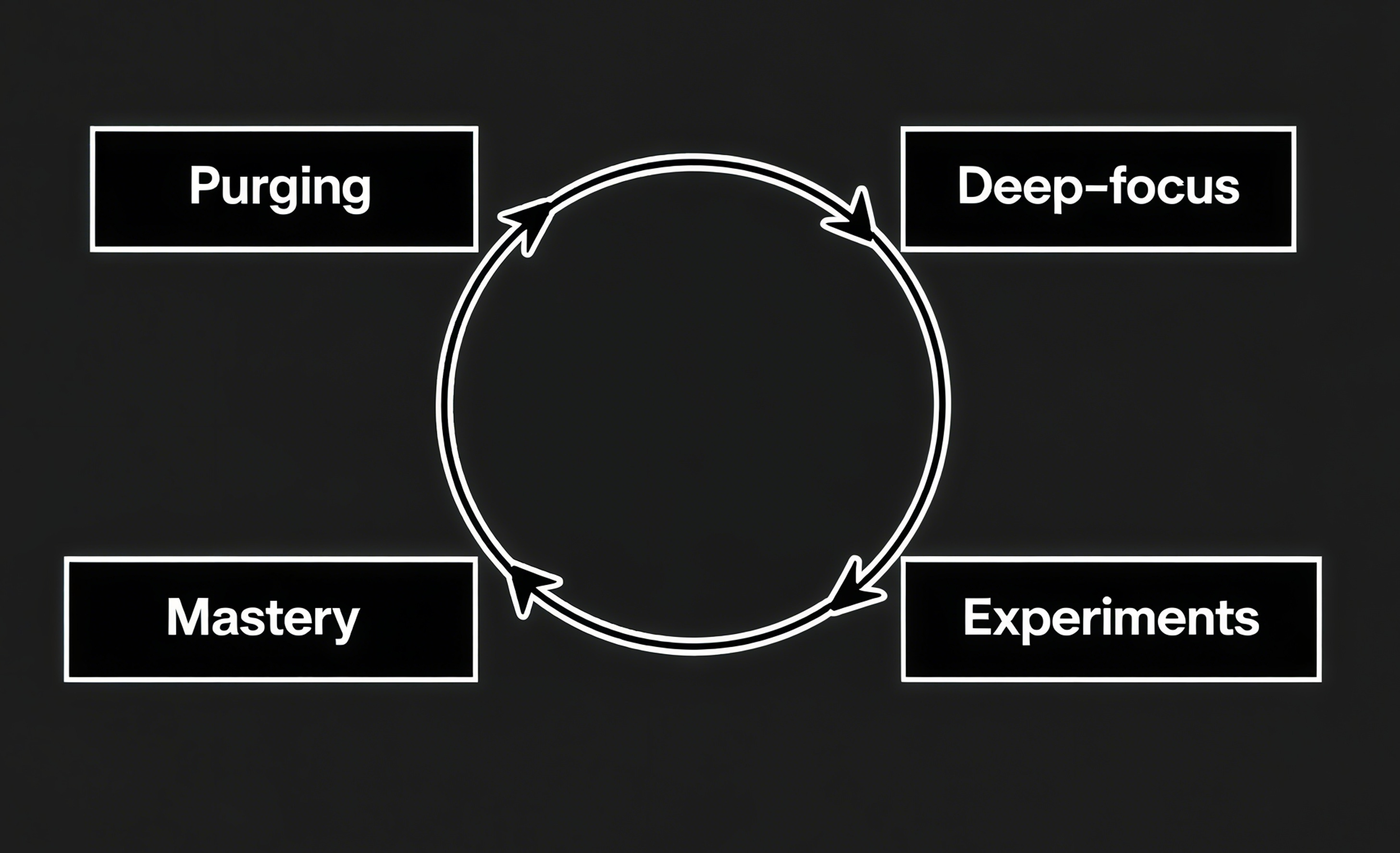
Purging
Life doesn’t stop for you. It keeps pulling. Kids. Boss’ texts or emails. Notifications. Stuff you never asked for but it’s in your face every day. That’s how the world is built — full of sand that clogs your gears.
Purging is where you clear that sand. You can’t vanish into a cave. But you can strip it down to “MVP” — minimum viable life. The bare minimum to keep going. You remove the obvious crap that drags you off course so you have space to breathe. This isn’t about being a monk forever. It’s about making room for what’s next.
Deep Focus
This is where you push yourself to the edge. Forget balance for a while. Throw yourself into the life you think you want. Live it like it’s already yours.
Everyone romanticizes the dream — freedom, money, travel, “do what you love.” They don’t talk about the mess underneath. The stress. The parts you can’t outsource. The loneliness maybe. Deep focus is how you test all of that, fast.
It’s like startups. You don’t spend years imagining. You ship the thing ASAP, see what breaks, and figure out if you actually want to live inside this world you’re building. Do you love it enough to put up with the ugly parts? Or do the negatives crush the positives? You only find out by doing it, not dreaming.
Experiments
After the sprint, you slow down. Add some of the noise back — friends, social stuff, maybe Netflix. Not all of it. Just enough to see how your “new life” holds up when it’s not protected inside a bubble.
This stage is messy. Most experiments fail. 99% even. But every failure is data. You learn what works, what doesn’t, and — most importantly — what feels right to you. Sometimes the noise shows you what you don’t need anymore. Sometimes you realize you cut something you actually wanted.
The point isn’t to get it right in one shot. The point is to know yourself better every time.
Mastery
Now you’ve got some signals. Things that didn’t fall apart when you tested them. Stuff that lights you up even after the grind. This is where you double down.
No secret here: practice. Maybe copy the best. Learn how the top creators write scripts, how the best data scientists analyze problems, why great artists choose certain details and not others. Not to become them — but to train your own hands and brain until it’s second nature. You have the filters in your eyes so that everything in the world will become your own library.
This is the simplest phase and also the hardest. You already know what to do. You just have to do it, over and over, without thinking too much.